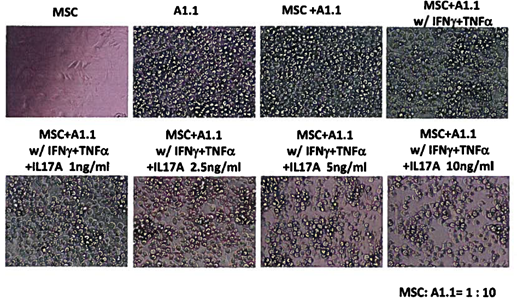
IL-17A promotes MSC-Mediated immunosupressive effect. Changes in cell proliferation as shown in microscopy
Invention Summary:
Autoimmune diseases occur when the immune system attacks the body’s tissue components. Mesenchymal stem/stromal cells (MSCs) have been used as treatment to many autoimmune disorders such as type 1 diabetes, rheumatoid arthritis, and multiple sclerosis. MSCs can be derived from various tissues and are multipotent stem cells that can differentiate into adipocytes, chondrocytes, and osteoblasts and are responsible for repairing and regenerating tissues. These cells are immune suppressive. MSCs have potential applications in treating autoimmune disorders, allergic reactions, and transplant rejections. It can also help engraftment of transplanted hematopoietic stem cells. MSCs can differentiated from embryonic stem cells or induced pluripotent stem (iPS) cells. While MSCs’ immunomodulation potential could depend on physiological and pathologic condition of patients’ health and treatment environment, MSCs’ response to inflammation is a key in determining therapeutic effects.
Rutgers researchers have developed a methodology to enhance MSC-mediated immunosuppression for clinical applications. Immunosuppression is found to be attributed to inflammatory cytokine production during an immune response. In the absence of inflammatory cytokines, MSCs do not possess immunosuppressive effects and could not achieve a potent inhibitory function of proliferation of activated T-cells. On the other hand, under low inflammatory conditions, MSCs can boost immune response by releasing chemokines and growth factors. Therefore, MSCs can be used to modulate immune responses.
Market Applications:
- The method using inflammatory cytokines to pretreat MSCs to modulate their immunosuppressive effect can be used in prevention and treatment of diseases such as multiple sclerosis, arthritis, lupus, hepatitis, cirrhosis, Parkinson’s disease, chronic infections and Graft-Versus-Host Disease (GvHD).
- New treatments that block tumor immunosuppressive properties associated with MSCs could be developed.
Advantages:
- In mouse studies, MSC-mediate immunosuppression is dependent on the presence of inflammatory cytokines leading to new treatments that are highly localized in tissue damage sites.
- The promotion of immunosuppressive effect by IL-17 is shown to enhance iNOS (inducible Nitric Oxide Synthase) expression by providing mRNA stability.
- Methodology can be used to screen reagents, or drugs can or inhibit or increase IDO expression in human MSCs
Intellectual Property & Development Status: Only U.S. patent rights are available for licensing. U.S. Patents 10,046,011, 10,898,523, 11,872,250, and 12,156,889 issued; U.S Patent Application 2024/0269188 pending. For any business development and other collaborative partnerships contact marketingbd@research.rutgers.edu